Not legal advice
This describes how the process generally works. Deadlines in your case may differ. If something has been filed against you, talk to a lawyer.
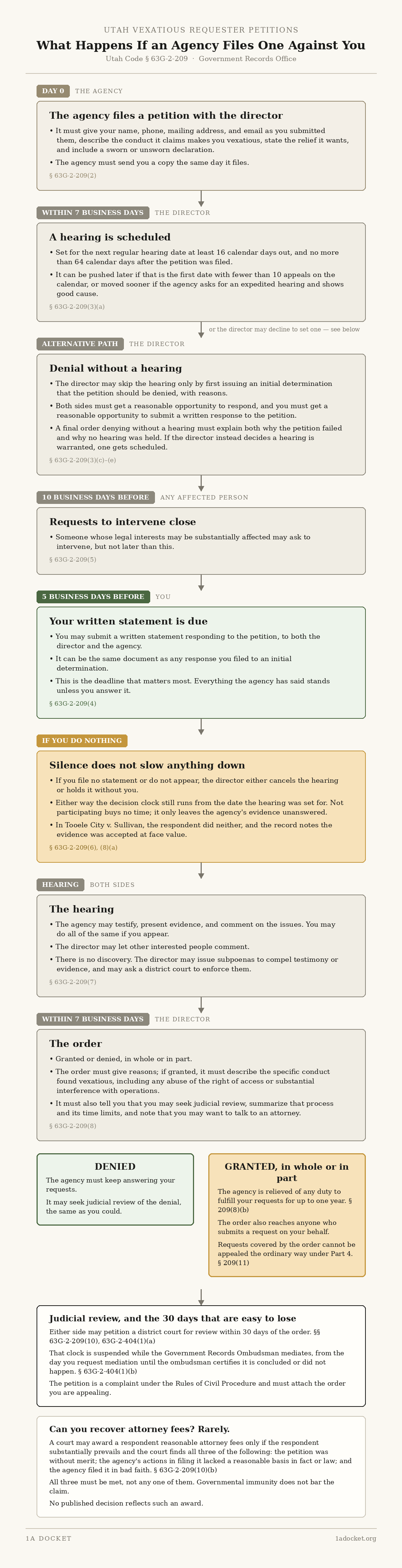
How a vexatious requester petition works
Filing through judicial review, and the deadlines that run against you.
The agency files a petition with the director
- It must give your name, phone, mailing address, and email as you submitted them, describe the conduct it claims makes you vexatious, state the relief it wants, and include a sworn or unsworn declaration.
- The agency must send you a copy the same day it files.
A hearing is scheduled
- Set for the next regular hearing date at least 16 calendar days out, and no more than 64 calendar days after the petition was filed.
- It can be pushed later if that is the first date with fewer than 10 appeals on the calendar, or moved sooner if the agency asks for an expedited hearing and shows good cause.
Requests to intervene close
- Someone whose legal interests may be substantially affected may ask to intervene, but not later than this.
Your written statement is due
- You may submit a written statement responding to the petition, to both the director and the agency.
- It can be the same document as any response you filed to an initial determination.
- This is the deadline that matters most. Everything the agency has said stands unless you answer it.
Silence does not slow anything down
- If you file no statement or do not appear, the director either cancels the hearing or holds it without you.
- Either way the decision clock still runs from the date the hearing was set for. Not participating buys no time; it only leaves the agency's evidence unanswered.
- In Tooele City v. Sullivan, the respondent did neither, and the record notes the evidence was accepted at face value.
The hearing
- The agency may testify, present evidence, and comment on the issues. You may do all of the same if you appear.
- The director may let other interested people comment.
- There is no discovery. The director may issue subpoenas to compel testimony or evidence, and may ask a district court to enforce them.
The order
- Granted or denied, in whole or in part.
- The order must give reasons; if granted, it must describe the specific conduct found vexatious, including any abuse of the right of access or substantial interference with operations.
- It must also tell you that you may seek judicial review, summarize that process and its time limits, and note that you may want to talk to an attorney.
The agency must keep answering you
Your requests continue to be processed as they were before.
The agency may seek judicial review of the denial, the same as you could.
Cut off for up to a year
The agency is relieved of any duty to fulfill your requests for up to one year. § 209(8)(b)
The order also reaches anyone who submits a request on your behalf.
Requests covered by the order cannot be appealed the ordinary way under Part 4. § 209(11)
Judicial review, and the 30 days that are easy to lose
Either side may petition a district court for review within 30 days of the order. §§ 63G-2-209(10), 63G-2-404(1)(a)
That clock is suspended while the Government Records Ombudsman mediates, from the day you request mediation until the ombudsman certifies it is concluded or did not happen. § 63G-2-404(1)(b)
The petition is a complaint under the Rules of Civil Procedure and must attach the order you are appealing.
Can you recover attorney fees? Rarely.
A court may award a respondent reasonable attorney fees only if the respondent substantially prevails and the court finds all three of the following: the petition was without merit; the agency's actions in filing it lacked a reasonable basis in fact or law; and the agency filed it in bad faith. § 63G-2-209(10)(b)
All three must be met, not any one of them. Governmental immunity does not bar the claim.
No published decision reflects such an award.
Download this chart as an image (PNG) — for printing, or to drop into a brief or a story.