Not legal advice
This describes how the process generally works. Deadlines in your case may differ. If something has been filed against you, talk to a lawyer.
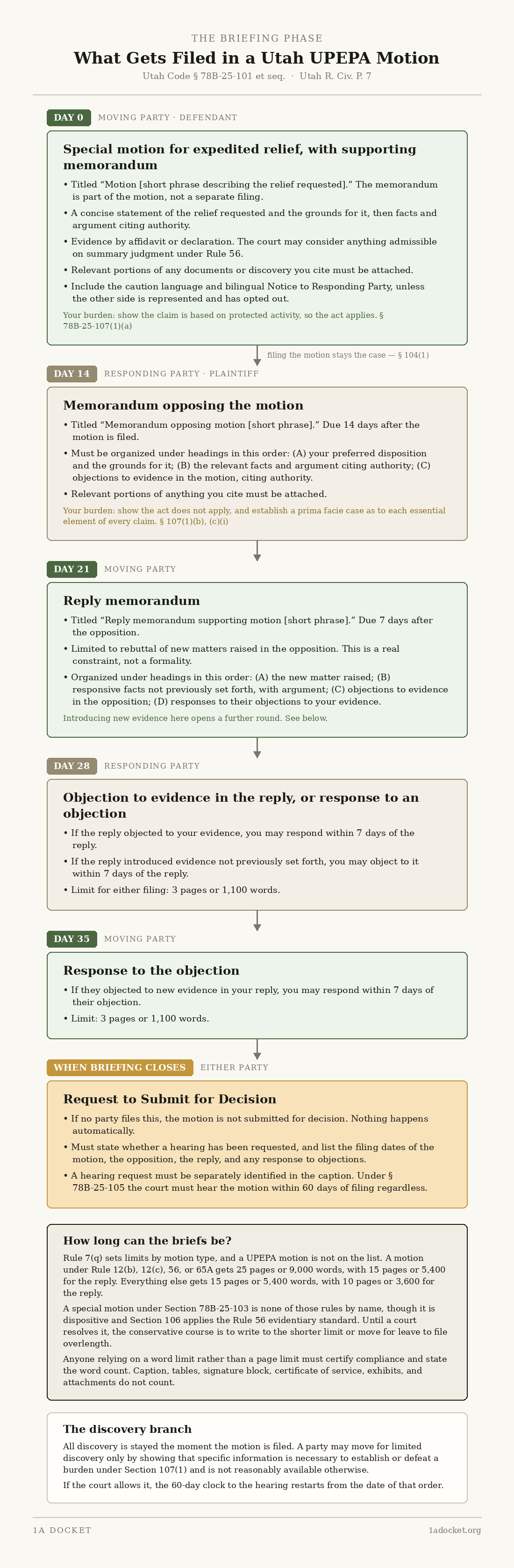
The briefing sequence
Who files what, when, and what has to be in it.
Special motion for expedited relief, with supporting memorandum
- Titled “Motion [short phrase describing the relief requested].” The memorandum is part of the motion, not a separate filing.
- A concise statement of the relief requested and the grounds for it, then facts and argument citing authority.
- Evidence by affidavit or declaration. The court may consider anything admissible on summary judgment under Rule 56.
- Relevant portions of any documents or discovery you cite must be attached.
- Include the caution language and bilingual Notice to Responding Party, unless the other side is represented and has opted out.
Memorandum opposing the motion
- Titled “Memorandum opposing motion [short phrase].” Due 14 days after the motion is filed.
- Must be organized under headings in this order: (A) your preferred disposition and the grounds for it; (B) the relevant facts and argument citing authority; (C) objections to evidence in the motion, citing authority.
- Relevant portions of anything you cite must be attached.
Reply memorandum
- Titled “Reply memorandum supporting motion [short phrase].” Due 7 days after the opposition.
- Limited to rebuttal of new matters raised in the opposition. This is a real constraint, not a formality.
- Organized under headings in this order: (A) the new matter raised; (B) responsive facts not previously set forth, with argument; (C) objections to evidence in the opposition; (D) responses to their objections to your evidence.
Objection to evidence in the reply, or response to an objection
- If the reply objected to your evidence, you may respond within 7 days of the reply.
- If the reply introduced evidence not previously set forth, you may object to it within 7 days of the reply.
- Limit for either filing: 3 pages or 1,100 words.
Response to the objection
- If they objected to new evidence in your reply, you may respond within 7 days of their objection.
- Limit: 3 pages or 1,100 words.
Request to Submit for Decision
- If no party files this, the motion is not submitted for decision. Nothing happens automatically.
- Must state whether a hearing has been requested, and list the filing dates of the motion, the opposition, the reply, and any response to objections.
- A hearing request must be separately identified in the caption. Under § 78B-25-105 the court must hear the motion within 60 days of filing regardless.
How long can the briefs be?
Rule 7(q) sets limits by motion type, and a UPEPA motion is not on the list. A motion under Rule 12(b), 12(c), 56, or 65A gets 25 pages or 9,000 words, with 15 pages or 5,400 for the reply. Everything else gets 15 pages or 5,400 words, with 10 pages or 3,600 for the reply.
A special motion under § 78B-25-103 is none of those rules by name, though it is dispositive and § 106 applies the Rule 56 evidentiary standard. Until a court resolves it, the conservative course is to write to the shorter limit or move for leave to file overlength.
Anyone relying on a word limit rather than a page limit must certify compliance and state the word count. Caption, tables, signature block, certificate of service, exhibits, and attachments do not count.
The discovery branch
All discovery is stayed the moment the motion is filed. A party may move for limited discovery only by showing that specific information is necessary to establish or defeat a burden under § 107(1) and is not reasonably available otherwise.
If the court allows it, the 60-day clock to the hearing restarts from the date of that order.
Download this chart as an image (PNG) — for printing, or to drop into a brief or a story.